Guide / reading a syringe
How to Read an Insulin Syringe
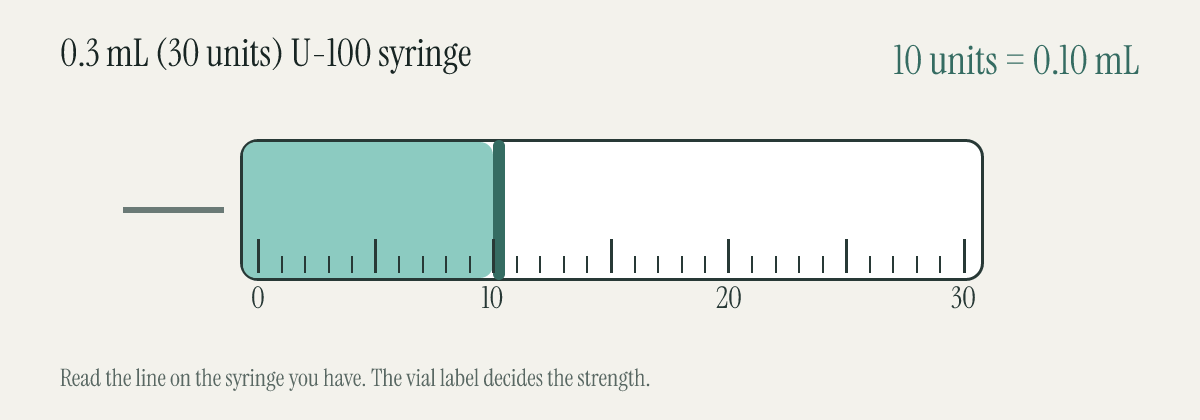
On a U-100 insulin syringe, 100 units fill 1 mL, so 1 unit is 0.01 mL. Compare the number with the lines printed on your own syringe and the edge of the plunger closest to the needle.
Last updated
First, check what kind of syringe you have
“Units” on an insulin syringe measure an amount of liquid, and each syringe is marked for one insulin strength. U-100 means 100 units fill 1 mL, so 1 unit is 0.01 mL. That works the same for any liquid you draw from a vial. But how many mg of medicine you get still depends on the vial’s strength (mg per mL). A line on the syringe can’t tell you the mg on its own.
If you see cc instead of mL, it means the same thing. A cc is a cubic centimeter, and NIST, the US measurement agency, says a milliliter is another name for a cubic centimeter. So on a U-100 syringe, 1 cc = 1 mL = 100 units, and 0.3 cc, 0.5 cc and 1 cc syringes are the 0.3, 0.5 and 1 mL sizes.
Before you read it, check that the syringe says U-100 and how much it holds: 0.3 mL, 0.5 mL or 1 mL. U-40 syringes use a different scale. ISO 8537, an international standard for insulin syringes, says a syringe must be marked for one insulin strength only. In the device facts we cite, an orange needle cap means U-100 and a red one means U-40. Never use a units number from one kind of syringe on another without checking the label.
Reading the syringe
Read the printed scale.
Use the edge of the plunger closest to the needle as the reference edge for the numbered lines. The zoomed-in view makes the same lines easier to read.
Which part of the plunger is the reference edge?
The rubber tip of the plunger is thicker than a line. embecta’s technique guide calls the reference the “thin black line of the plunger”; other device guides call it the top of the plunger, and Lilly’s Zepbound vial instructions call it the “plunger tip.” These names refer to the edge closest to the needle. Don’t use the far side of the rubber.
If your dose falls between two lines, the syringe cannot measure it precisely. Stop and verify your medication strength and syringe size with your healthcare provider or pharmacist before injecting.
How far apart the lines usually are (and why yours may differ)
In the US, 0.3 mL and 0.5 mL syringes commonly have a line for every unit, and 1 mL syringes a line for every 2 units. Half-unit markings are common on 0.3 mL syringes. These are common setups, not a rule. embecta’s data lists 0.3 and 0.5 mL syringes with lines every unit, plus 0.3 mL syringes with half-unit lines, and 1 mL syringes with lines every unit or every 2 units. The ISO 8537 standard leaves the line spacing up to each maker, based on their own risk and usability testing.
That’s why the safest advice is: read your own syringe. Don’t guess how far apart the lines are from the syringe size, a photo, or a different brand. A 1 mL syringe holds more, but when its lines are 2 units apart it can be harder to measure a small amount. A 0.3 mL syringe may measure in smaller steps, but your amount still has to fit, and you still need to check the lines printed on it.
An example: from mg to units
Say the strength is 2.5 mg/mL and your prescribed dose is 0.25 mg. The math is 0.25 ÷ 2.5 = 0.10 mL. On a U-100 syringe, 0.10 mL × 100 = 10 units. A syringe with a line every unit has a line at 10, and so does one with a line every 2 units. Now change the strength to 10 mg/mL. The same 0.25 mg becomes 0.025 mL, or 2.5 units. A typical 1 mL syringe with lines every 2 units can’t show 2.5 exactly.
Use your prescribed mg and the strength printed on the vial as two separate checks. If the answer is much bigger or smaller than you expect, or smaller than your syringe can measure, don’t just quietly round it. Check again that the vial strength is in mg/mL, that the syringe is U-100, and that the syringe size fits the amount.
Common questions
What does U-100 mean?
U-100 means 100 units fill 1 mL, so 1 unit is 0.01 mL.
Is 1 cc the same as 1 mL?
Yes. A cc is a cubic centimeter, which is the same volume as 1 mL. On a U-100 syringe, 1 cc = 1 mL = 100 units, so 0.1 cc is 10 units.
Which part of the plunger is the reference edge?
The top of the plunger (the edge closest to the needle). Manufacturers call it the thin black line, the top of the plunger, or the plunger tip.
Are all 1 mL syringes marked every 2 units?
No. That’s common, but manufacturers also make 1 mL syringes with a line for every unit. Read the lines printed on your own syringe.
Sources
The medical and device facts on this page come from these sources. Each entry shows the date we accessed it.
- 01 Technical Data Sheet – Insulin Syringes · embecta, Rev B, 12/2025. Accessed 2026-09-28.
- 02 Injection technique guide · embecta, ©2025, EMB-05148. Accessed 2026-09-28.
- 03 ISO 8537:2016, sterile single-use insulin syringes · International Organization for Standardization, 2016. Accessed 2026-09-28.
- 04 Zepbound single-dose vial Instructions for Use · Eli Lilly, 04/2026. Accessed 2026-09-28.
- 05 UltiCare U-100 Insulin Syringes · UltiMed. Accessed 2026-09-28.
- 06 SafetyGlide Insulin Syringes quick reference guide · embecta. Accessed 2026-09-28.
- 07 SI units: volume · National Institute of Standards and Technology. Accessed 2026-10-01.
Medically reviewed by Ashley Alexis, NDLast reviewed How we review